1 · Hot-water outlet
Draws from the upper high-temperature layer; outlet geometry should avoid mixing.

Thermal storage engineering
Material selection, corrosion control, insulation, hydraulics and stratification are as important as collector area. Final thickness and pressure rating require approved design data.
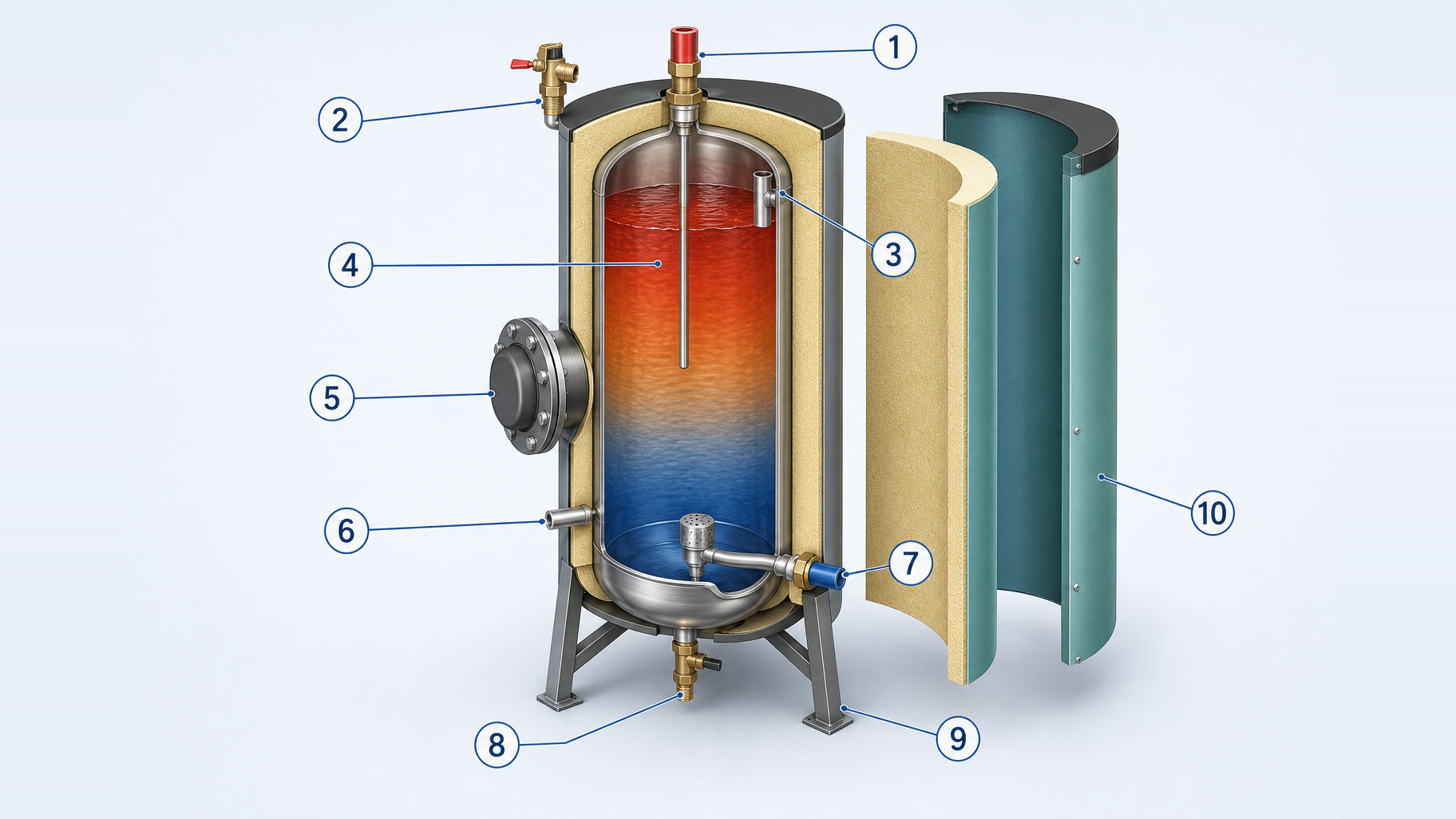 Conceptual educational cutaway—not a construction or manufacturer drawing.
Draws from the upper high-temperature layer; outlet geometry should avoid mixing.
Protects against unsafe conditions; discharge piping must terminate safely.
Measures a selected control layer without exposing the sensor directly to pressure.
Hot water remains above cooler water; insulation surrounding the inner vessel slows loss.
Provides project-specific access for inspection, cleaning or protected backup provision.
Returns cooled loop water at a level chosen to limit mixing.
Introduces make-up water gently at the lower cold zone.
Enables controlled emptying, flushing and sediment removal.
Transfer the full operating load safely to the prepared base.
Protects the PUF insulation and inner vessel from weather and handling damage.
Good corrosion resistance for many potable-water conditions, hygienic surface and low routine coating maintenance. Chloride, welding quality, passivation and water chemistry still matter. Common choice for premium domestic and institutional storage.
Economical zinc-protected steel. Suitable only when coating continuity, fabrication, operating temperature and water chemistry are controlled; cut edges and welds need proper protection. Inspect for zinc loss and corrosion.
A glass-forming enamel slurry is applied to prepared steel and fused at high temperature, creating a hard, chemically resistant barrier. Unlike field-applied epoxy, fused enamel is inorganic and heat resistant, but chips or pinholes must be controlled. A magnesium anode protects exposed steel.
Use a replaceable magnesium anode, compatible fittings, dielectric isolation where dissimilar metals meet, double-layer insulation, sealed vapour barrier and weatherproof outer cladding in powder-coated GI, aluminium or stainless steel.
A convex/dished bottom assists drainage and strength; a low cold-water diffuser reduces mixing; the hot outlet draws from the upper zone. Floating draw-off can follow the hottest layer. Dip-tube and nozzle design must prevent short-circuit flow.
SS304: higher initial cost, strong all-round option. Glass-lined MS: cost-effective, excellent when lining and anode maintenance are controlled. GI: economical for selected water/temperature conditions, but requires closer corrosion observation. PUF insulation commonly ranges 50-100 mm by duty; final value follows heat-loss design.