1 · Tempered solar glass
Admits short-wave sunlight and limits convective loss while protecting the absorber.

Flat Plate Collector learning centre
A flat plate collector converts short-wave solar radiation into heat at a selectively coated absorber, transfers it to water through risers and headers, and stores the energy in an insulated tank.
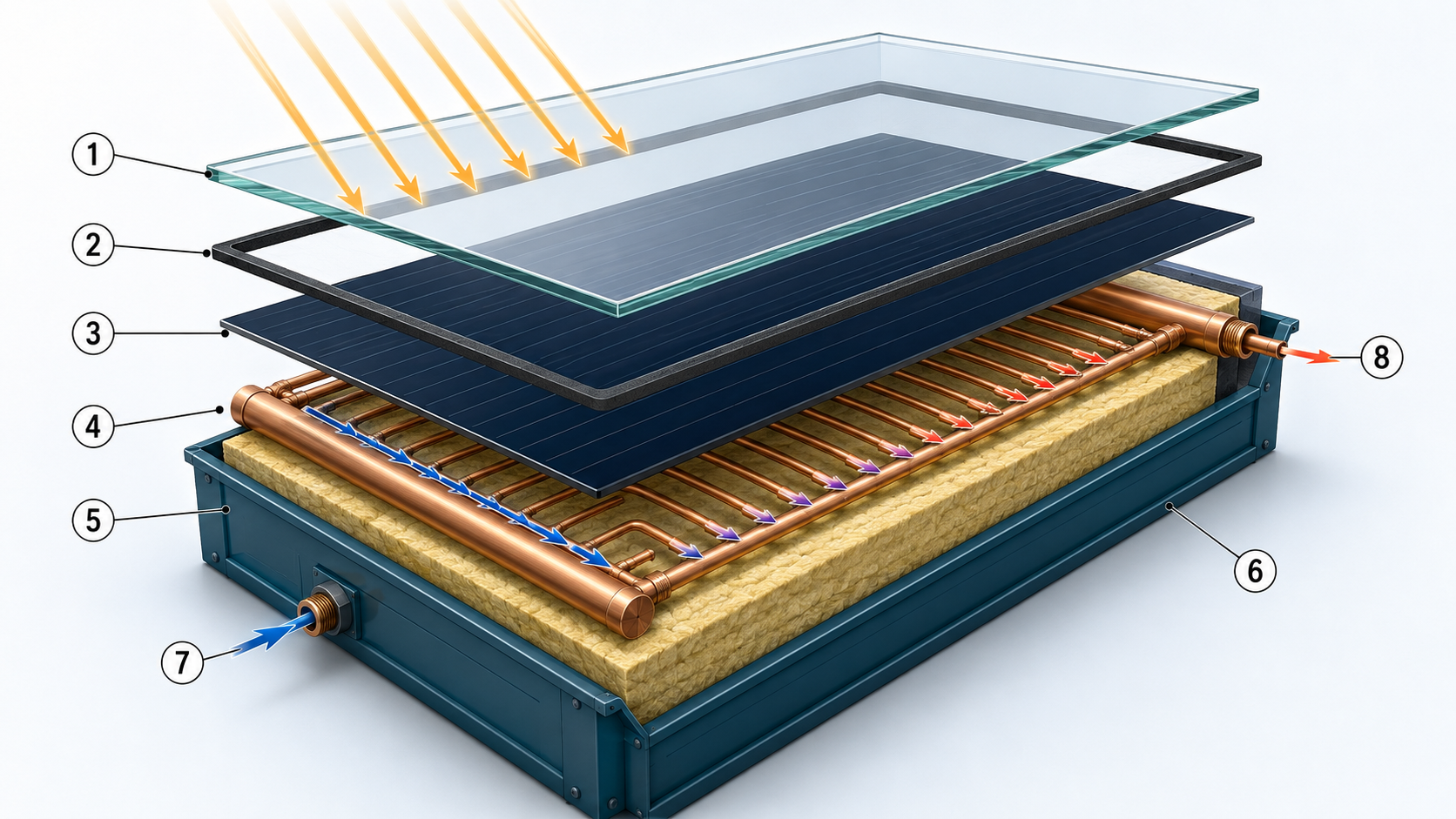 Conceptual educational cutaway—not a construction or manufacturer drawing.
Admits short-wave sunlight and limits convective loss while protecting the absorber.
Keeps rain, dust and humid air away from the insulated collector box.
Dark metal surface absorbs high solar energy while limiting thermal re-radiation.
The lower header distributes cooler return through bonded risers; the upper header collects heated flow.
PUF or mineral wool slows conduction through the rear and sides.
Provides weather protection, mechanical support and mounting points.
Admits cooler tank/loop water to the lower header.
Carries collector-heated flow toward the tank or heat exchanger.
Passive circulation
The tank must be above the collector. Density difference drives flow without a circulation pump; large or poorly arranged piping can stop the loop through air locks and excessive resistance.
Advantages
Limitations
Complete setup
Actual quantity, pressure class, pipe material and safety devices follow capacity, water quality, building pressure and the approved product data sheet.
Captures heat and fixes the approved tilt/orientation against wind loads.
Stores useful heat with top hot draw-off, low cold inlet and stratification.
Carries flow while allowing collectors, valves and tank connections to be serviced.
Releases trapped air at high points and enables flushing or maintenance drainage.
Control pressure, prevent reverse flow, relieve unsafe conditions and isolate equipment.
Accepts fluid expansion and stabilises pressure in indirect/pressurised systems.
In active systems, runs only when collector temperature can usefully charge the tank.
Reduces distribution loss and protects insulation from UV, rain and damage.
Installation sequence
Demand, roof, shade, structure and water test
Select capacity, direct/indirect loop and tank material
Fix supports, orientation, tilt and maintenance clearance
Mount collector/tubes and tank without stressing connections
Install insulated piping, valves, vents, drains and controls
Flush, fill slowly, remove air, leak/pressure test
Verify flow direction, safety relief and temperature rise
Record settings, train user and issue maintenance plan