1 · Cold return inlet
Introduces cooler loop water to the manifold/header.

Evacuated Tube Collector learning centre
An ETC uses concentric borosilicate glass tubes. A vacuum between the layers suppresses convection and conduction losses while a selective coating converts sunlight into heat.
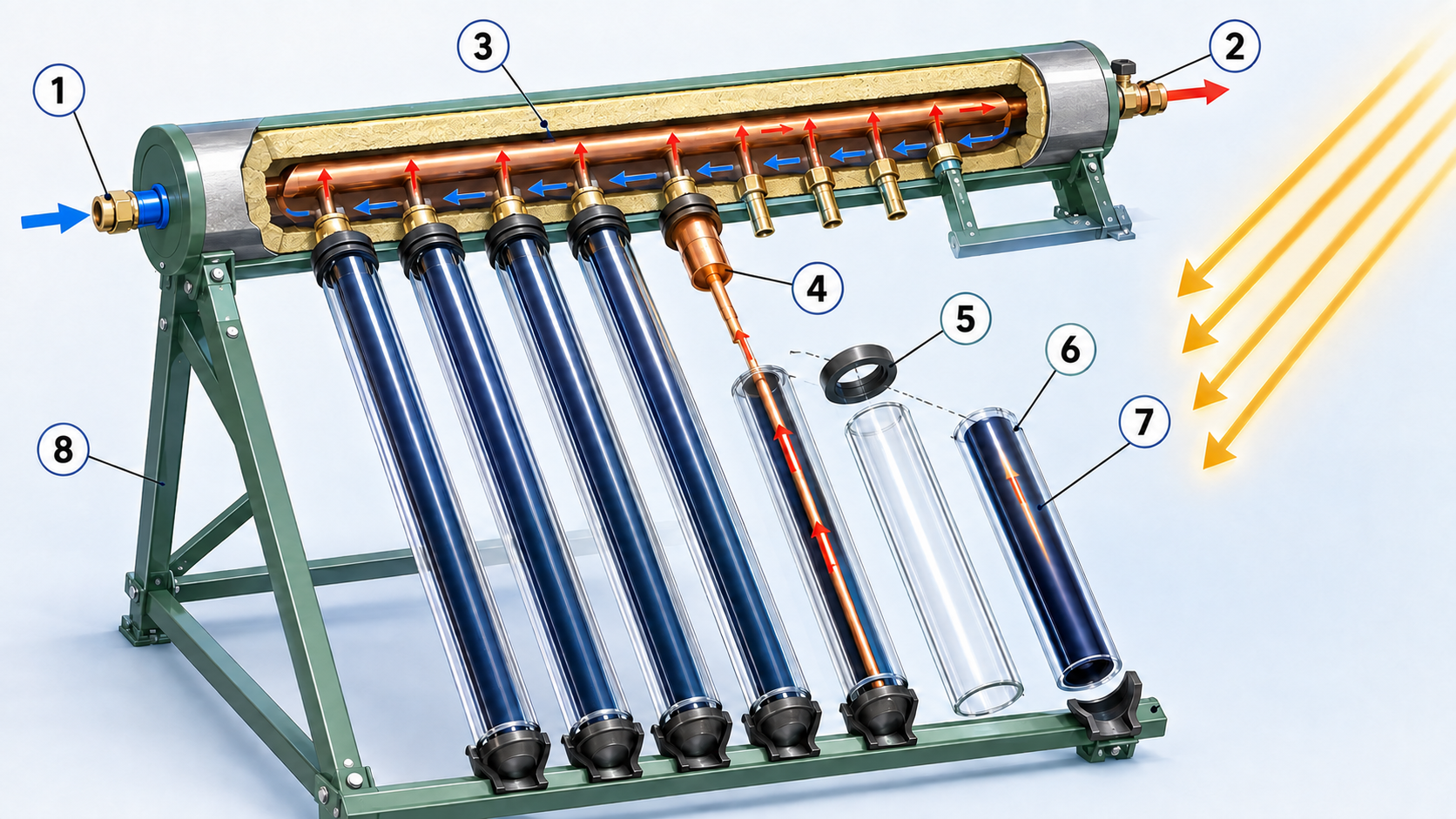 Conceptual educational cutaway—not a construction or manufacturer drawing.
Introduces cooler loop water to the manifold/header.
Carries absorbed solar heat toward storage.
Collects heat from tube necks or condensers while limiting standby loss.
A sealed copper heat pipe transfers heat to its condenser in the manifold.
Supports the glass neck and reduces water, dust and abrasion at the opening.
Transparent borosilicate envelope admits solar radiation and encloses the vacuum gap.
The coated inner tube absorbs radiation; the surrounding vacuum suppresses heat loss.
Holds manifold and tube ends at the approved inclination and spacing.
Passive circulation
The tank must be above the collector. Density difference drives flow without a circulation pump; large or poorly arranged piping can stop the loop through air locks and excessive resistance.
Advantages
Limitations
Complete setup
Actual quantity, pressure class, pipe material and safety devices follow capacity, water quality, building pressure and the approved product data sheet.
Absorbs solar radiation with low heat loss; tube number follows model and capacity.
Receives heat from wet tubes or heat-pipe condensers and limits standby loss.
Support glass safely, maintain alignment and reduce leakage or abrasion.
Introduces make-up water gently at the lower tank zone to protect stratification.
Provides an engineered relief path; its discharge must terminate safely.
Sacrificially protects exposed steel and must be inspected as a consumable part.
Optional project-specific backup with dedicated protection—not assumed on every system.
Support sediment removal and material-compatible descaling in hard water.
Installation sequence
Demand, roof, shade, structure and water test
Select capacity, direct/indirect loop and tank material
Fix supports, orientation, tilt and maintenance clearance
Mount collector/tubes and tank without stressing connections
Install insulated piping, valves, vents, drains and controls
Flush, fill slowly, remove air, leak/pressure test
Verify flow direction, safety relief and temperature rise
Record settings, train user and issue maintenance plan